Salt Fractionation
All the ingredients are available from your local market/drugstore. The trick is to find a dye that works for acetone, but will not color water- believe it on not blue glitter will color the acetone nicely and not change the salt water. Follow this link for details:
ChemEd X: Blog of Prof. Tom Kuntzleman
Of course Amazon has what you will need:
From Amazon: BUY NOW
acetone, blue glitter, food coloring, cool bottle
Note: this site contains affiliate links for which I may be compensated
Salt Fractionation: two liquids that won’t stay mixed! Acetone (dyed blue) floats on top of the higher density salt water (dyed orange). Acetone usually dissolves in water through hydrogen bonding interactions, but solubility can be altered. In a process called “salting out” a sufficient amount of salt is dissolved such that the water molecules, which are much more attracted to the resulting Na+ and Cl- ions (through ion-dipole bonds), will then ignore the weaker acetone hydrogen bonds. This results in the spontaneous separation (shown here in real time) of the liquids no matter how well shaken up.
Surfs Up Wave Machine
This Simpson's themed wave machine was made back in 1999-2000 and is hard to find. Here is a fairly inexpensive wave machine that has a similar base mechanism:
From Amazon: BUY NOW Liquid Wave Machine
Note: this site contains affiliate links for which I may be compensated
Surf's Up Wave Machine: Bart rides a surfboard between two immiscible liquids which are sorted under gravity by density with the densest (dyed water) on the bottom and the lightest (mineral oil) on top. Bart’s board has a density between that of the two liquids so it stays at the boundary layer, and a capsule of air above Bart’s head keeps him upright. The motorized rocking mechanism in the base is powered by one C cell battery and produces the waves at the boundary layer by sloshing and colliding the dense liquid off each end. Found this rare 1999 toy on eBay.
The Square Wave
Own this scuplture by Ivan Black (made in collaboration with Italian manufacture house Atellani):
From Art of Play: BUY NOW Square Wave
Note: this site contains affiliate links for which I may be compensated
The Square Wave: an interactive kinetic sculpture of 24 interlocking right angle metal rods from the mind of artist Ivan Black. Waves propagate, folding the structure into a tight curl- and a reverse snap will bring it back to the initial flat square state. An important design feature is that each right angle rod is limited to move through about 45 degrees, and all through parallel axes, allowing for the beautiful rotational wave motion via a cascade of angular momentum transfer.
The Orb Drop IV
A new KickStarter campaign from engineer and maker extraordinaire Rian Suiter. Rian has delivered on each all 11 (eleven!) of his creative physics toy related KickStarter campaigns to date. Check out his latest here:
From KickStarter: Order NOW Orb Drop IV marble run track
Note: this site contains affiliate links for which I may be compensated
The Orb Drop IV: @orbdrop has created another fun DIY marble run- this one uses an Archimedean screw mechanism to bring the marbles continuously back to the top where they are launched along one of three paths- including a vortex funnel. Gravitational potential energy is transformed to the kinetic energy of the orbs as they loop and negotiate the banked turns of the snaking tracks. Three AA batteries and a small motor power the transport assembly.
Argon Phosphor Plasma Globe
This interesting version available here:
From Amazon: BUY NOW Purple-Green Plasma Globe
Note: this site contains affiliate links for which I may be compensated
Argon Phosphor Plasma Globe: high voltage glow discharge of low pressure argon in a mix of gasses which create plasma filaments that emit line spectra mostly at frequencies between blue and ultraviolet. The UV emissions then excite a thin coating of phosphors to produce the green light. A small high frequency coil at center creates the high voltage potential between the center electrode and a very thin metal coating on the glass globe. This unique version of the plasma globe was found in a shipment of @thecuriositybox by the Vsauce team- a great way to start your own physics toy collection!
The Radiometer
Available from these sources:
From Educational Innovations: BUY NOW Radiometer
A wide variety available here, including some nice blown glass displays:
From Amazon: BUY NOW Radiometers
Note: this site contains affiliate links for which I may be compensated
Invented by William Crookes, a brilliant chemist and discoverer of the element Thallium, the core of the device is a balanced assembly of four small squares each painted black on one side and silver on the other, and mounted on a glass spindle. This assembly is called the fly. The fly is placed on a needle point which serves as a bearing that provides minimal friction. The tricky part of the construction is that the bulb needs to be almost (but not completely) evacuated of air to make a functioning radiometer. The was hard to do in 1876, yet the technology to do so, a Geissler mercury vacuum, was just invented a couple years earlier and Crookes had one in his lab.
As one can see from the video, the fly within the radiometer spins with the silver sides leading and the black sides following. Many great names in physics have worked on a credible physical explanation for why the fly spins at all, and the radiometer was at the center of the debate of whether light is a wave phenomenon or could be described as small particles. (We now know the answer is both, but that is another story!) The famous physicist connected to fluid dynamics, Osborne Reynolds (of the eponymous Reynold’s number) came up with the best explanation in 1879. The light energy is absorbed by the fly and its panels heat up. The fly is then propelled by gas moving from the hotter black side to the cooler white side of each panel. More than 40 years later, none other than Albert Einstein showed that Reynold’s effect was not enough for the measured speed of rotation, and in a paper published in 1924 (only available in German it seems) gave further details of how thermomolecular flow near the edges of the panel contribute significantly to the generation of rotation.
A note of caution: Most radiometers found in museum gift shops (and in many online catalogs) have packaging that claims the device shows the presence of radiation pressure− while it has been long shown that light radiation does exert pressure, radiometers do not in fact operate on this principle!
Ambiguous Object Illusion Mug
From Etsy: BUY NOW Squirkle Mug Ambiguous Object Illusion
These type of objects were invented by mathematician Kokichi Sugihara, and you can buy his books here:
From Amazon: BUY NOW Ambiguous Objects by Kokichi Sugihara
The math and physics are described here in this technical journal article by Prof. Sugihara.
Note: this site contains affiliate links for which I may be compensated
Ambiguous Object Illusion Mug: circle or a square? It’s all a matter of perspective and viewing angle. The complex shape allows for both to be perceived and is based on the work of mathematician Kokichi Sugihara of Meiji University in Japan, the inventor of this illusion and art form.
Dither Image Encryption
I got this set as part of the Gathering 4 Gardner gift exchange. For those with coding skills- here's the python script:
From GitHub: Dithercript
Note: this site contains affiliate links for which I may be compensated
Dither Image Encryption: three images hidden in random dither patterns are revealed by precisely overlaying and aligning any two patterns in the generated set. Amazingly each pattern holds two encrypted images where b+c=♣, a+b=♦, and c+a=♥. These patterns were created by Dithercrypt, a shared python script created by Andy Lutomirsky. The concept of entropy is shared between physics and cryptography, and gives a measure of the randomness inserted and strength of the key.
Kalliroscope with Convection Stand
Click this link for the best Kalliroscope currently in production and available.
Note: this site contains affiliate links for which I may be compensated
Kalliroscope with Convection Stand: visualizing convection currents. Invented and produced by Paul Matisse in the 1970s, suspended microscopic flat crystals of guanine reflect light and allow visualization of the fluid's motion. This rheoscopic fluid is special in that the guanine crystals are the same density as the tetrachloroethylene liquid so the crystals never settle to the bottom allowing the fluid to show the slightest movement. The stand is only about 5 degrees C warmer than room temperature- enough to create the convection currents seen here- due a heating element (a simple resistor) in the base.
Vintage Telephone Magneto
vintage magnetos are available here:
From Etsy: BUY NOW Vintage Bar Magneto Generators
Note: this site contains affiliate links for which I may be compensated
Vintage Telephone Magneto: a functioning antique 5 bar telephone magneto generator- made in 1910! As indicated by the neon bulb voltage divider- with sufficient cranking speed this generator can create a significant AC voltage using the characteristic horseshoe shaped magnets (bars) to provide the induction field. The AC current is of a low frequency as indicated by the flickering bulbs. A digital storage oscilloscope allows us to view the AC waveform output of this vintage magneto generator (swipe for demo). Note that although the output voltage is periodic, it is far from the ideal AC sine wave that we learn about (like those off the mains into our homes). Faraday’s Law describes the produced current in a moving coil of copper near a magnetic field, but it takes careful engineering of the coil and field to produce a sinusoidal AC output. The scope shows an impressive peak voltage of more than 350V- note that in 1910 only 40% of US homes had electricity so these generators were used to ring telephone bells up to 20 miles away!
Gas Collection for Emission Spectra
I made the display holder and I got this set of gas tubes here (about $7 per tube):
From Amazon: BUY NOW: Gas Pure Element Samples
Here is the miniture tesla coil used in the video:
From engineDIY: BUY NOW: Mini Tesla Coil
Note: this site contains affiliate links for which I may be compensated
The breakdown voltages of the elements featured in this post are described by Paschen's Law:
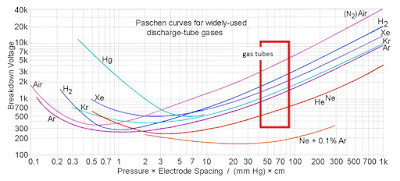
Here is a excellent article with an overview of the physics of glow discharge and its application in lighting and other technologies.
Gas Collection for Emission Spectra: pure samples of hydrogen, nitrogen and five noble gasses are subjected to the high frequency pulsed field of a miniature Tesla coil. Each gas has a characteristic breakdown voltage and emission spectrum- note that Nitrogen has the highest breakdown voltage and only glows when very near the coil where the field is most intense whereas Neon and Helium have the lowest breakdown voltage and begin to glow many centimeters away from the coil. The color of each gas is due to a mix of the colors emitted from electron energy transitions specific to each element- the basis of spectroscopy. The Krypton tube also exhibits interesting oscillations with this particular Tesla coil.
The Levitron
Levitron Tops were produced in the 1990s and are out of production and getting harder to find. Similar models are still available here:
From Amazon: BUY NOW: Levitation Top
Note: this site contains affiliate links for which I may be compensated
The Levitron: spin stabilized magnetic levitation- will fly for about 3 minutes or more per launch. The spin rate of the magnetic top must be just right for flight, not too fast or too slow. Air resistance and dissipative interactions between the magnets gradually slow the spin rate and the top falls. Interestingly trapping the top requires precision - the weight of the top must be adjusted to within 1 gram to achieve equilibrium between the pull of gravity and the magnetic repulsion from the large donut shaped magnet in the wood base.
Sodium Fluorescein
Fluorescein dye is inexpensive and solutions of it easy to make and experiment with:
From Amazon: BUY NOW Fluorescein
Note: this site contains affiliate links for which I may be compensated
Sodium Fluorescein: this organic compound acts as a special dye that absorbs energy of blue and UV light and then emits it as green light. In daylight a solution of fluorescein will appear to have a strange green highlight, but when illuminated from behind it is yellowish gold in color due to absorption of all the blue and green light that tries to pass through. This sample of fluorescein solution is encased in acrylic and made in to this odd paperweight I found on eBay. A fun physics find!
Copycoder
Get one here:
From Mindsets: BUY NOW Copy Coder
Note: this site contains affiliate links for which I may be compensated
Copycoder: clever use of an array of cylindrical lenses to scramble and unscramble large font messages- a modern "secret code" toy. The refractive optics invert slivers of an image to encode or decode it. You can scramble an image by photocopying a message covered with the array plate, or go to copycoder.com and a program will scramble a message that you can print out to send to anyone that also has the lens array. Invented by Steve Ostler from the UK. Fun!
Lava Lamp in Time-lapse
Available here in many colors and sizes:
From Amazon: BUY NOW: Lava Lamps
Note: this site contains affiliate links for which I may be compensated
Lava Lamp in Time-lapse: 15 minutes compressed into 15 seconds gives a different perspective on the processes involved in this classic physics toy from the 1960's. Mesmerizing physics of convective heat flow, Archimedes principle, and immiscible liquids. Manufactured by Mathmos and invented in 1963 by Edward Walker of Dorset England, the Lava Lamp is still popular today and is available in a wide range of colors.
Switch Pitch Ball
Get one here:
From Edicational Innovations: BUY NOW: Switch Pitch Ball
Note: this site contains affiliate links for which I may be compensated
Switch Pitch Ball: this spherical assembly changes color by turning inside out when tossed into the air. A favorite of my mechanical toys with surprising physics. Interestingly the advertisements for this toy incorrectly claim air drag is involved in the transformation. To understand why the ball inverts first note that the ball is made of multiple components hinged together. In launching the ball from the hand an upward acceleration results in a torque that pivots each component around its center of mass, causing the rotation of these components in an organized way leading to the transformation. Imagine tossing a stick straight up. If the stick is perfectly vertical upon launch it will move straight up- but if it is initially slanted at all it will also begin to rotate upon launch. Similar physics underlies the motion of each component of the ball- shown here in 240 fps slow motion. The Switch Pitch is produced by the makers of the Hoberman Sphere.
Tesla Coil
For the price, this is the best one on the market I think and beautiful to look at in copper- the music function does not do much, but it is a great little Tesla coil and it comes with three accessories for the top. Please be sure to employ all appropriate safety precautions when utilizing any electrical circuity!
From engineDIY: BUY NOW: Mini Tesla Coil
Note: this site contains affiliate links for which I may be compensated
Tesla Coil: miniature low current version of the famous air core double-tuned resonate transformer invented by Nikola Tesla in 1891. The thick copper of the primary coil is set into three windings around the many windings of the tall secondary coil. This one uses a modern transistor circuit to excite the radio frequency oscillations that produce a voltage in excess of 50kV in the form of pulses that cycle about 100k times a second. This version is fed by a 24V DC power supply and is fairly safe due to a low current (mA)- but the circuitry does get hot and demands a huge heat sink with fan (the metal base can burn skin when operating). The coils comes with attachments- the spike produces a purple corona discharge as the voltage exceeds the breakdown voltage of air with current flowing into the air or arcing over to a grounded piece of metal. The corona discharge imparts momenta, and here the ends of a bent wire are set into rotation from the slight push of the escaping electrons. Swipe to see the ejected electron stream propel the end of a thin wire into a final state circular orbit. The more interesting behavior occurs during the initial transient orbits which seem to be hypotrochoid type curves beautifully captured here using the Slow Shutter app.
Mendocino Motor
Get one here:
From engineDIY: BUY NOW Solar Levitating Motor (on all models here-remove brown protective film to reveal clear acrylic on rotor)
Note: this site contains affiliate links for which I may be compensated
Mendocino Motor: each face of solar cell is connected to a coil of copper wire under the opposing solar cell. When the rotor is lit from above the top solar cell provides electric current to the coil in the bottom position which becomes a temporary electromagnet that pushes against the permanent magnet in the base propelling the rotor to rotate. As the rotor turns, the coil that moves into the bottom position is likewise energized by the solar cell currently at the top- one can say the light commutates this motor. 2D magnetic levitation is provided by permanent magnets where an acrylic plate constrains the third dimension, and makes for a nice bearing surface for minimal friction. Invented in the 1960s by Daryl Chapin of Bell Labs and popularized by Larry Springs of Mendocino CA
