Optical Trick Portraits
If you are ever in Florence be sure to visit the Galileo Museum and see the original- as well as a collection of Galileo's telescopes and experiments.
Visit: Museo Galileo
Optical Trick Portraits: Hold a flat mirror up to this painting of Charles III, Duke of Lorraine, to reveal his daughter Christina in this 1593 work by Ludovico Buti. A very early example of lenticular images, Gioco Ottico hangs in the Galileo Museum in Florence as part of the Medici Collections. I got this toy version from the museum gift shop a couple months ago.
Eames Era Kinetic Art
These vintage atomic art pieces are almost always available on eBay and Etsy:
From eBay: BUY NOW Atomic Kinetic Art
From Etsy: BUY NOW Kinetic Atomic Art
Eames Era Kinetic Art: a spray of harmonic oscillators (masses on spring steel wire) produce hypnotic motion in this vintage art piece from the early 1970s. Kinetic sprays like this are mostly from designer Laurids Lonborg of Denmark and can also serve as earthquake detectors. Not recommended for households with cats!
Magnetic Fluid Patterns
Visit the Exploratorium
Get your own ferrofluid display- Click on this link!
Magnetic Fluid Patterns @exploratorium: a dark ferromagnetic fluid, trapped in a small gap between two plates of glass, reacts under the influence of a powerful magnetic field in this exhibit at the Exploratorium in San Francisco. The intricate and beautiful fluid patterns result from surface tension between the liquids competing with the ferrofluid attempting to align with the field lines of a strong magnet as it is positioned at different distances underneath. ? With special thanks to the Exploratorium!
Monochromatic Room
The light source in this exhibit produces a frequency at 589nm
Wikipedia has a nice description of the physics and applications of Sodium Vapor Lamps
Visit the Exploratorium
Monochromatic Room @exploratorium: a photo of colorful San Francisco is illuminated by a very narrow frequency band of light, with a wavelength of 589nm- the characteristic spectrum of sodium vapor lamps at low pressure. Seeing color is both about the source of illumination and how an object interacts with light. Here a white LED flashlight can momentarily “paint” the scene with color. Sodium vapor lights are a type of gas-discharge lamp that uses sodium metal vapor in an excited state with two dominant spectral lines at 589.0 and 589.6nm, producing the bright yellow light in this exhibit. ? Thanks to the @exploratorium!
Pendulum Snake
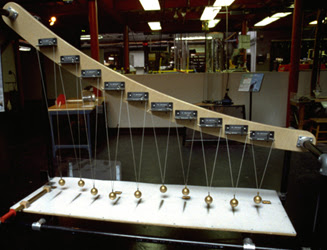
This exhibit include labels for the exact period of each pendulum:
This Exploratorium "snack" describes how to build your own with simple supplies: Pendulum Snake
Visit the Exploratorium
Small versions you can buy are available here:
From Amazon: BUY NOW Pendulum Snake
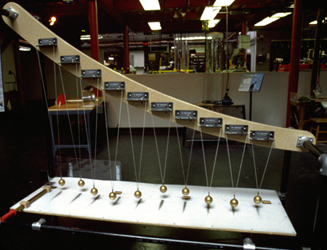
Pendulum Snake- one of my favorite exhibits at @exploratorium: ten swinging spheres, the first has a frequency of 15 swings per 30 seconds, the second has 16 in the same time, the third has 17, up to the tenth with 24 swings per 30 seconds. If released at the same time and height the amazing patterns result as each independent pendulum goes in and out of phase with the rest. Note that for a pendulum the frequency of oscillation depends on the square root of its length. ? With special thanks to the Exploratorium!
Equilateral Triangular Kaleidoscope
This inexpansive kaleidoscope is available here:
From increadiblescience: BUY NOW: Moire Tube Kaleidoscope
Click here for affordable, precision made scopes with angled mirrors: Kaleidoscope Symmetries Explored
See more kaleidoscopes in my collection: Kaleidoscopes
Equilateral Triangular Kaleidoscope: three mirrors arranged in a 60-60-60 degree triangle creates the appearance of a plane filled with triangles (or equivalently a honeycomb lattice)- perhaps the most common mirror configuration design, this inexpensive kaleidoscope produces an excellent example of the reflection pattern. As a bonus the exterior tube on this scope incorporates a kinetic Moirè pattern. The kaleidoscope was invented by the famous Scottish physicist Sir David Brewster (1781-1868), and has become an entire field of artistic endeavor.
Heng Balance Lamp
Many models and colors to choose from, available here:
From Amazon: BUY NOW
Heng Balance Lamp
Heng Balance Lamp: magnetic suspension sculpture and light- with two neodymium magnets on cords suspended by their mutual magnetic attraction. In this design by Zanwen Li, the bottom cord engages the light switch.
Mini Balance Pterosaur
Get similar prehistoric balance beasts here:
From Amazon: BUY NOW Balance Pterosaur
Mini Balance Pterosaur: weights in the forward wing tips create a center of mass below this pterosaur's beak- making a system that can rotate and oscillate about a stable equilibrium condition. No magnets used or needed for this physics! Usually this toy is found in the form of a bird (direct dinosaur descendent). Pterosaurs are not dinosaurs, but are the largest animals to ever fly, and powered flight has only evolved four times: bats, birds, pterosaurs, and insects- in reverse order.
Magnetic Cube
Many colors to choose from:
From MagneticCube.com: BUY NOW Magnetic Dice Cube
See also the original indestructibles post: Magnetic Acrylic Rubik's Cube
Magnetic Cube: a twisty Rubik’s Cube puzzle made from 27 dice and 108 neodymium magnets. This cube includes the scrambled states and solutions of the original 3x3 Rubik’s Cube but is held together only by magnets! The magnets, in this special configuration, lock the dice together with a satisfying click upon rotation. This beautiful cube was produced by Owen Lillywhite of magneticcube.com and is based on a gfixler design posted on instructables.
Magneview Flim
Get some magnetic viewing film here:
From Educational Innovations: BUY NOW Magnetic Viewing Film
Magneview Flim: making the invisible visible and revealing the hidden physics of our everyday world. Microscopic cavities in this green film are filled with oil and tiny flakes of Nickel metal- like compass needles, the flakes align with the magnetic fields revealing the complexity of the north and south pole domains of these magnets. Two of the disk magnets have multiple north and south poles and look like gears with teeth- these are rotors from small motors.
Slinky Treadmill
Learn more about the physics of the slinky here: Exploratorium Science Snack
The slinky has been a popular toy since 1945! Read about the history and physics of the slinky, and the naval mechanical engineer that invented it on Wikipedia.
Visit the Exploratorium
Slinky Treadmill by @exploratorium: kinetic motion energy transfers to elastic potential energy and then back to kinetic energy in a cycling process as a slinky spring "walks" down an incline. Put the system on a treadmill, such as this one at the Exploratorium in San Francisco, and the walking behavior can be explored for many minutes. Note that after a while the slinky's walking becomes erratic.? With special thanks to the Exploratorium!
Anamorphic Projection Puzzle
This vintage puzzle was made in Germany about 30 years ago by "Dr. F Hein Spiele", and unfortunately there does not seem to be anything like it currently on the market. This is a table top version of anamorphic projection. Here is an example of large scale versions:
Anamorphic Projections of Felice Varini via Colossal
See similar art in my collections: anamorphic projections
Anamorphic Projection Puzzle: multiple layers of images, fragments of letters and colors, assemble into an image of a smiling sun if viewed from a very specific view point. Thanks to Mark Setteducati for sending me this vintage item.