Magnetic Sand Disk Display
This device was made possible by this Spirok Kickstarter Campaign
Spirok products available here: Spirok Ferrofluid Devices
See my video of the amazing BT Speaker Display
Note: this site contains affiliate links for which I may be compensated
Magnetic Sand Disk Display: a unique combination of suspended ferromagnetic grains and rheoscopic platelets create this artistic interface to allow visualization of magnetic fields. Here the field of a multipole ring magnet from a motor is revealed. This disk is yet another wonderful creation from my friend Tim and the Spirok team.
Bent Space Timer Sandglass
I got my timer here:
From Science Decor: BUY NOW: Bent Sandglass
Note: this site contains affiliate links for which I may be compensated
Bent Space Timer: Happy Near Year and watch time march on via an interesting twist on a standard sandglass- this 30 second timer has the sand move through a bend which sets up a regular pulse as air and sand exchange places from top to bottom.
Sander Illusion
Get this nice 3D print here:
From Etsy: BUY NOW: Sander Illusion Box
Note: this site contains affiliate links for which I may be compensated
he Sander Illusion: contrary to our perception the diagonals of the adjacent parallelograms are the same length. Optical illusions like this one are studied by cognitive psychologists and often give insights to processes of vision and the brain. This nice 3D print allows a physical confirmation that the diagonals are indeed identical in length.
Kinetic Sandscapes by KB
Sandscape art from Klaus Bösch available here:
From Amazon: BUY NOW: Sandscapes by KB
Note: this site contains affiliate links for which I may be compensated
Follow this link to learn more about Mr. Bösch's art (since 1988)
Kinetic Sandscape: by Klaus Bösch, aka “The Sandman”, the originator of the sand+water+bubble form of these kinetic art pieces. The phenomenon of spontaneous stratification is a striking feature of these Sandpictures. Typically pouring stuff together results in further mixing, yet here, when the sand mixture descends through a gap in the air bubbles, the resulting pile is ordered into sorted layers. The larger rounded dark grains separate from the smaller sharp-edged white grains forming the layers you see here. The darker grains alone would stack into a steeper pile (larger angle of repose) than the white which would form a less steep pile. The stratification process is a slow one in this device, here each transformation takes about 40 minutes or more- shown here using iPhone time lapse.
Sand Snowman Paperweight Toy
Similar sand toys available here:
From Amazon: BUY NOW: Sand Paperweight Toys
Note: this site contains affiliate links for which I may be compensated
Sand Holiday Paperweight Toy: physics of granular materials- matter with unique properties between those of solids and liquids- as demonstrated with this simple toy. Granular materials, such as the sand in this toy, flow but also stack with a characteristic “angle of repose” as can be seen here as pyramid like ridges that form over the images of Santa and winter wonder.
Sandscape Spontaneous Stratification
Get this particular sand kinetic art here:
From SfK: BUY NOW: Sandscape Kinetic Desk Toy
Click here for more amazing types of kinetic sand art.
Note: this site contains affiliate links for which I may be compensated
Sandscape Spontaneous Stratification: a striking feature of this sand motion desk toy is the formation of striped layers. Typically pouring stuff together results in further mixing, yet here, when the sand mixture descends through a gap, the resulting pile is ordered into sorted layers. The larger rounded dark grains separate from the smaller sharp-edged white grains forming the layers you see here. The darker grains alone would stack into a steeper pile (larger angle of repose) than the white which would form a less steep pile.
Kinetic Sandscape
This version is very well made and shows the phenomena of spontaneous stratification better than most versions I've seen:
From Amazon: BUY NOW Kinetic Sandscape
Note: this site contains affiliate links for which I may be compensated
Kinetic Sandscape: the phenomenon of spontaneous stratification is a striking feature of this sand motion desk toy. Typically pouring stuff together results in further mixing, yet here, when the sand mixture descends through a gap in the air bubbles, the resulting pile is ordered into sorted layers. The larger rounded dark grains separate from the smaller sharp-edged white grains forming the layers you see here. The darker grains alone would stack into a steeper pile (larger angle of repose) than the white which would form a less steep pile. The stratification process is a slow one in this device, here about 30 minutes have been condensed to the 60 second IG format.
Sand Shaker
See more photos and video of this amazing exhibit at the artist's online gallery: Sand Shaker by Charles Sowers
Visit the Exploratorium
Note: this site contains affiliate links for which I may be compensated
Sand Shaker @exploratorium: a thin layer of white sand is subjected to vibrations on top of a circular plate in this exhibit created by artist Charles Sowers at the Exploratorium in San Francisco. When granular substances like sand are rapidly shaken, they often take on the properties of fluids through a process called vibrofluidization. Strange non-Newtonian fluid behavior is seen in this sand when the frequency of vibration is adjusted to 16Hz (shown here in 240fps slow motion)- amazing complexity arising from simple and regular motion! ? With special thanks to the Exploratorium!
Sand Pendulum
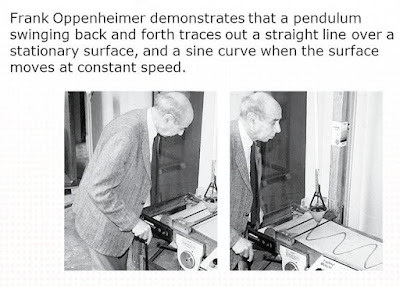
Frank Oppenheimer, founder of the Exploratorium Museum, demonstrates the sand pendulum display in these images from the 1970s.
Visit the Exploratorium
Sand Pendulum @exploratorium: a swinging pendulum maps out a beautiful sine curve on to a conveyor belt. The belt moves at constant speed such that the sand creates a graph of the pendulum’s position as a function of time. With special thanks to the Exploratorium!
Magnetic Sand Hourglass
Get one from these fine sources:
From Amazon: BUY NOW Magnetic Hourglass
Note: this site contains affiliate links for which I may be compensated
Magnetic Sand Hourglass: ferromagnetic sand collects above a neodymium magnet in the wood base. Each particulate of ferromagnetic iron becomes a temporary dipole magnet in the presence of the magnetic field in the base. The tiny dipoles link up north ends to south ends, creating interesting patterns that reveal the magnetic field lines.
Magic Sand Wand Puzzle
This puzzle was produced in the 1990s, sometimes found on eBay (currently two avialable):
Wikipedia has a good introduction to the possible mechanisms of the Brazil nut effect
Magic Sand Wand Puzzle: this week’s physics brain teaser- move the steel ball through the sand to the other end of the tube. Amazingly it can be done in less than 6 seconds! Hint: spinning won’t help this time. The solution to this vintage puzzle relies on some interesting physics concerning granular convection. Answer below and swipe to reveal solution.
Note: this site contains affiliate links for which I may be compensated
Sand Paperweight Toy
Available from these fine sources:
From Amazon: BUY NOW Sand Globe Toys
From Amazon: BUY NOW Sand Globe Toys: Winter Theme
Note: this site contains affiliate links for which I may be compensated
Wikipedia has a nice introduction to the amazing world of granular material science
Sand Paperweight Toy: physics of granular materials- matter with unique properties between those of solids and liquids- as demonstrated with this simple toy. Granular materials, such as the sand in this toy, flow but also stack with a characteristic “angle of repose” as can be seen here as pyramid like ridges that form over the images of penguins.
Dual Axis Sand Pendulum
Available in many styles and colors:
From Amazon: BUY NOW Sand Pendulum
Note: this site contains affiliate links for which I may be compensated
Dual Axis Sand Pendulum: the kinetic energy trades back and forth between swinging toward the support arm and then swinging perpendicular to that path tracing Lissajous figures in the sand. The sand slowly dissipates the energy and the traced figures get smaller so the next one fits inside the last. Coupled oscillations like this can occur when multiple modes of motion (degrees of freedom) are available to the system.
